
Welcome to my website, where you'll feel right at home. I'm Sherif, and I've created this space just for you. Let's explore together!
No compatibility? Fine, then give us a washed and filtered unit!!!

No compatibility? Fine, then give us a washed and filtered unit!!!

No compatibility? Fine, then give us a washed and filtered unit!!!

Transfusion Medicine Misconception
This post discusses a common misconception in transfusion medicine: the belief that washed,irradiated or filtered blood units can resolve compatibility issues.
The following explanation clarifies why blood processing does not affect red cell antigen compatibility.
Blood Transfusion Compatibility

"No compatibility? Fine, then give us a washed and filtered unit!!!"

This is a question from a colleague: "Peace be upon you. In the blood bank where I work, we have a case that required several units, but there is absolutely no compatibility. We informed the treating physician of the situation, but he isn't convinced. He asked, 'Why don’t you just process it as washed and filtered units?' This is what the treating physician said, and we hear the same thing from others in various cases. How should we respond to this point?"

First, we must clarify exactly what the compatibility (crossmatch) test is for.

The Goal of Compatibility As we’ve agreed, during crossmatching, we are trying to determine if the patient’s body contains any alloantibodies directed against any antigens on the donor’s red blood cells (the unit being transfused).
Washing We generally wash blood to remove as much as possible of the substances surrounding the cells (plasma proteins, etc.).
Filtering (Leukoreduction) We filter to remove the maximum amount of leukocytes (white blood cells) from the unit.
Irradiation We use radiation to deactivate the donor's T-cells so they don't attack the recipient's body (preventing Graft-vs-Host Disease).

The Core Conflict

If a patient has alloantibodies or even autoantibodies against specific antigens on the donor cells, does performing any of those three procedures—or even all of them—change anything?
Immunohematology Made Easy (2)

Immunohematology Made Easy (2)
General Topics – Key Principles and Everyday Practices

📘 Available now in PDF & EPUB formats
🔗 Visit Store


The answer is no.

These procedures have no effect on the antigens present on the red blood cells; the antigens remain there regardless. If the patient is compatible with the donor’s cells, they will be compatible whether the unit is standard, washed, filtered, or irradiated. If the patient is incompatible with the donor’s cells, they will remain incompatible regardless of any processing the unit undergoes.

Understanding the Physician's Perspective

What is the treating physician thinking in these situations? There are a few common mindsets:
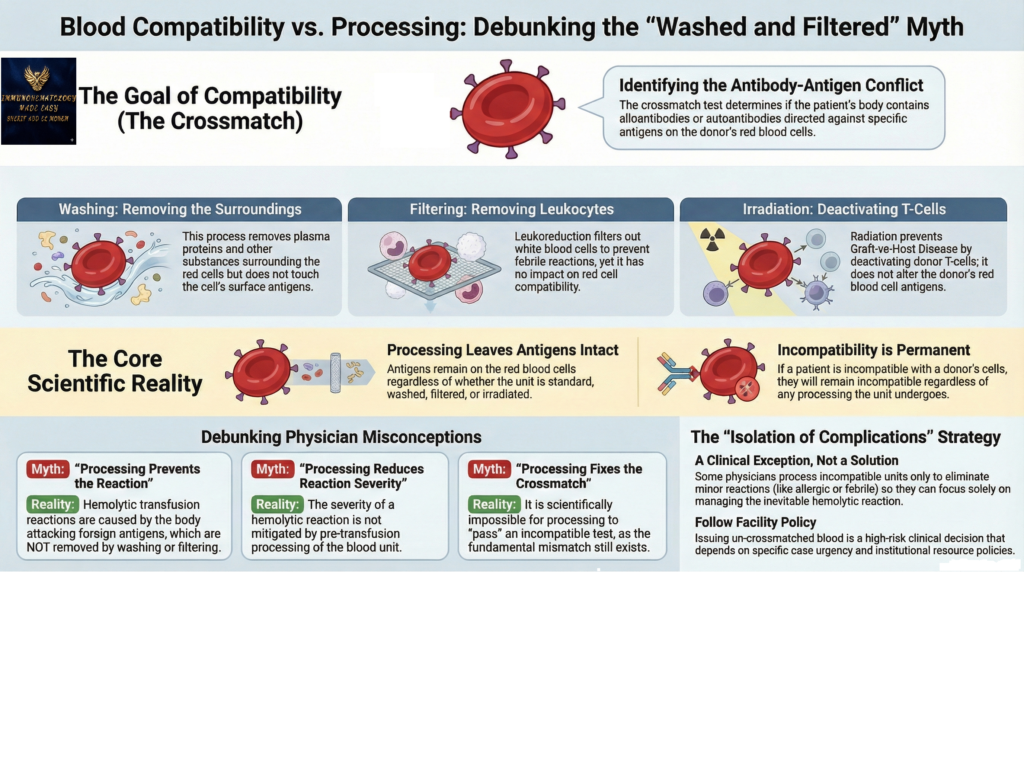
The Misconception: Some believe that processing the unit will somehow "fix" the compatibility test and make it pass.
Our Response: We have already addressed why this is scientifically impossible.
The "Safety Net" Theory: Some physicians know the test won't change, but believe these procedures will prevent a reaction in the patient’s body once the incompatible blood is transfused.
Our Response: This is incorrect. If this were true, no one would bother with crossmatching! Each procedure (washing, filtering, etc.) targets specific complications, but a hemolytic transfusion reaction (the body attacking the foreign cells) is entirely unrelated to what was removed during those processes.
The "Severity Reduction" Theory: Some believe that while a reaction will occur, these procedures will at least reduce its severity.
Our Response: Also incorrect. The severity of a hemolytic reaction is not mitigated by washing or filtering the blood.
The "Isolation of Complications" Strategy: Some physicians know a hemolytic reaction is inevitable but want the unit processed to eliminate other potential reactions (like febrile or allergic reactions). This way, they only have to manage the hemolytic reaction without other distracting symptoms.
Our Response: This is a different conversation altogether. It depends on the specific clinical case, available resources, and facility policy, as it essentially involves issuing "un-crossmatched" blood.
If any of us still held these misconceptions, hopefully, this clears things up. We should strive to correct these common errors whenever we encounter them.
Scientific Summary: Blood Compatibility

Scientific Summary

Compatibility testing (crossmatching) is performed to detect clinically significant antibodies in the patient’s plasma that may react with antigens present on donor red blood cells. If such antibodies are present, transfusion of incompatible blood may result in hemolytic transfusion reactions.

Blood processing procedures such as washing, leukoreduction (filtering), and irradiation are designed to reduce specific transfusion-related complications. However, these procedures do not alter or remove red blood cell antigens.

Therefore:
  • Compatible units remain compatible after processing.
  • Incompatible units remain incompatible after processing.
  • Washing, leukoreduction, and irradiation do not prevent hemolytic transfusion reactions caused by antigen–antibody incompatibility.

These procedures are useful for specific clinical indications but do not resolve immunohematologic incompatibility.

Immunohematology Made Easy (2)

Immunohematology Made Easy (2)
General Topics – Key Principles and Everyday Practices

📘 Available now in PDF & EPUB formats
🔗 Visit Store
Key Points: Blood Compatibility
!

Key Points

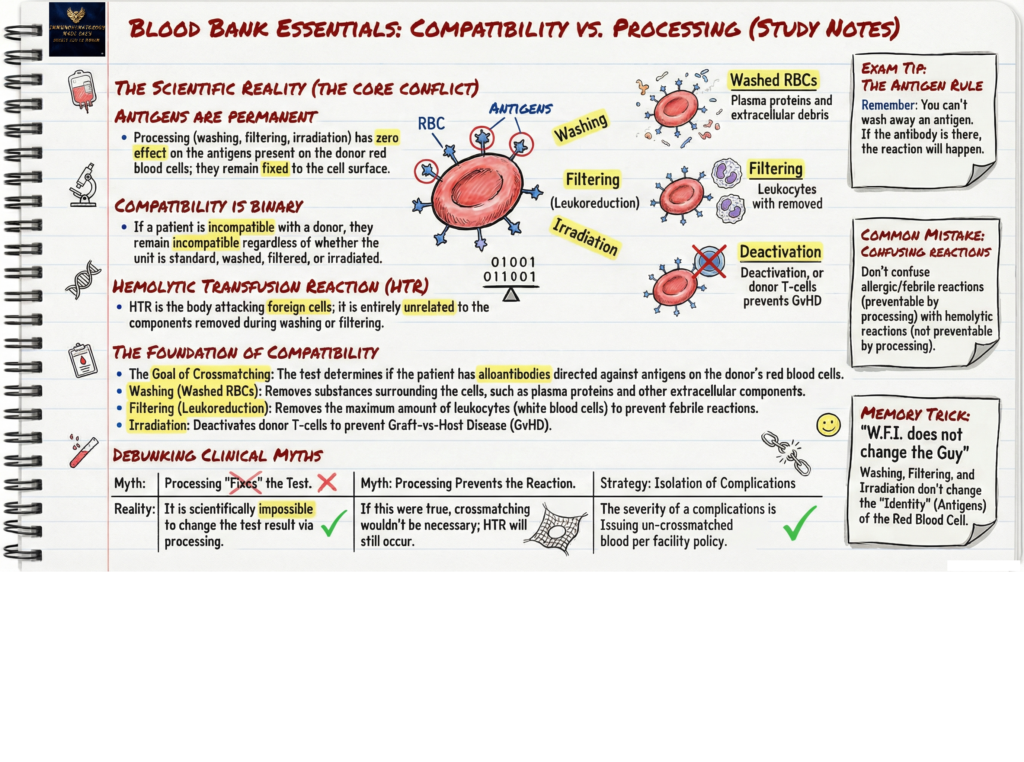
  • Crossmatch detects antibodies against donor RBC antigens
  • Washing does NOT remove RBC antigens
  • Filtering does NOT remove RBC antigens
  • Irradiation does NOT remove RBC antigens
  • Incompatible blood remains incompatible
  • Processing does NOT prevent hemolytic reactions
Clinical Takeaway
!
Clinical Takeaway
Washed, leukoreduced, or irradiated units may reduce certain transfusion reactions, but they do not prevent hemolytic transfusion reactions caused by incompatibility.
Sherif Abd El Monem - Profile

Sherif Abd El Monem

Founder | Immunohematology Made Easy
Alexandria, Egypt
English Groups
Arabic Groups
#BloodBank #TransfusionMedicine #Crossmatch #Immunohematology #BloodTransfusion #PatientSafety
Share it
Immunohematology Made Easy (2)

Immunohematology Made Easy (2)
General Topics – Key Principles and Everyday Practices

📘 Available now in PDF & EPUB formats
🔗 Visit Store
Immunohematology Made Easy Book

📘 New to Blood Bank?

Start your 5-day journey with Immunohematology Made Easy — a simple, beginner-friendly guide with real-life examples!

👉 Get Your Copy Now

Leave a Reply

Your email address will not be published. Required fields are marked *